

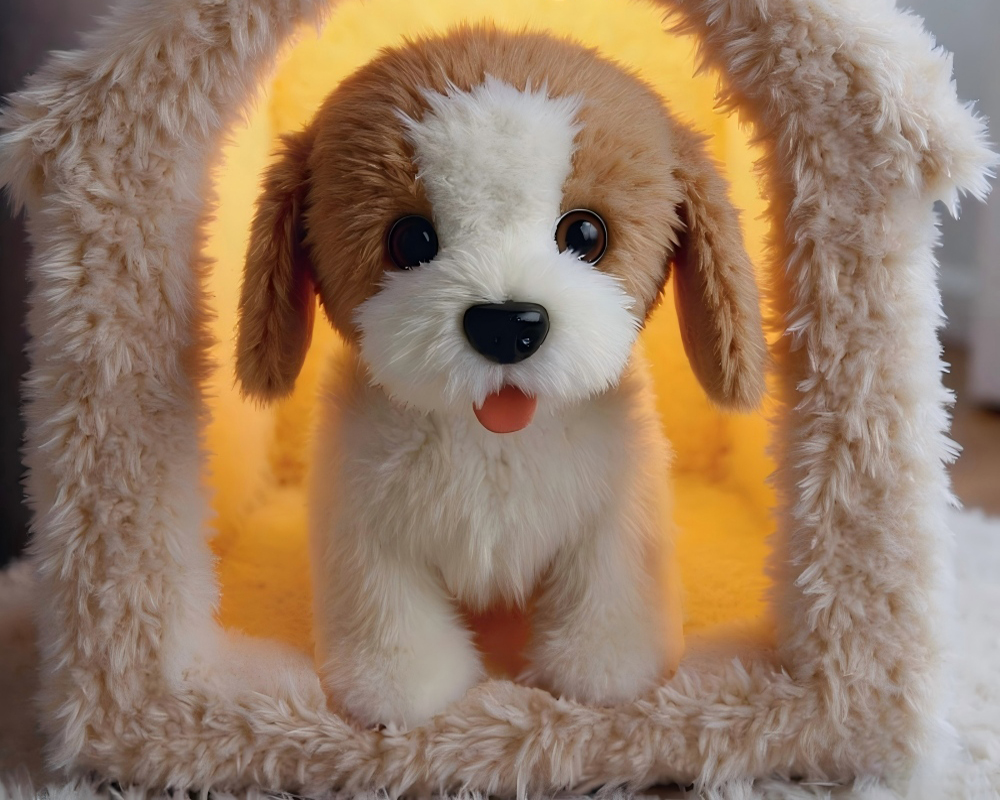
A toy dog may look simple on the shelf, but an interactive one is a different product to develop.
Once a plush dog can walk, bark, move its head, or respond with other actions, the manufacturer has to deal with much more than appearance. The internal mechanism, sound, movement, materials, battery system, assembly, and outer fur all need to work together.
For brands planning to launch a smart electric toy dog, this is where OEM and ODM manufacturing can make a real difference. Instead of building every part of the product from scratch, a brand can work with an experienced manufacturer to develop, modify, and produce a toy that fits its target market.
The important part is knowing what should be customized, what should remain practical, and how the final product will perform in real-world use.

🐶 Why Is a Smart Electric Toy Dog Different From a Regular Plush Toy?
A traditional plush dog mainly depends on its appearance, softness, and character design. An interactive toy dog has another job: it needs to create a response when a child plays with it.
For example, the JIAHANG interactive toy dog can nod its head, walk around, stick out its tongue, and bark like a real puppy. Electric music adds another layer of interaction and makes the toy more lively during play.
These functions may sound straightforward, but they require careful product development.
The manufacturer needs to fit the electronic and mechanical components inside the body without making the toy uncomfortable to handle or changing its puppy-like appearance. At the same time, the movement needs to feel natural enough to keep children interested. That combination of plush appearance + mechanical movement + sound interaction is what makes this type of toy different from an ordinary stuffed animal.

🔧 How Can ODM Make Product Development Easier?
ODM can be useful when a brand wants to launch an interactive toy without developing every component independently.
An experienced toy manufacturer may already have product structures, manufacturing processes, materials, and interactive functions that can serve as a starting point. The brand can then work with the manufacturer to adjust the design according to its own market.
For example, a basic electric toy dog may be adapted through:
- Fur color and appearance
- Facial details
- Clothing or accessories
- Sound and music
- Movement functions
- Packaging
- Brand logo and visual identity
- Product positioning
This approach can save development time compared with creating an entirely new product from zero.
It also gives brands more room to test a concept before investing heavily in a completely new production system.
💡 When Does OEM Make More Sense?
OEM is generally more suitable when the brand already has a clear product concept.
Maybe the brand has its own character design. Maybe it wants a specific appearance or interaction pattern. Or perhaps it has already decided how the toy should fit into an existing children’s product line.
In this situation, the manufacturer takes the brand’s requirements and works on turning them into a production-ready product.
For a smart electric toy dog, that can involve adapting the internal structure around the desired body shape, movement, sound, and exterior materials.
The outside may look like a simple puppy, but the inside still needs enough space for the mechanisms and components to operate reliably.
This is why OEM development requires more than simply sending a design file to a factory.

🧸 What Should Brands Customize?
Not everything needs to be customized.
In fact, trying to change every detail can make development unnecessarily complicated. A better approach is to identify the elements that actually help the product stand out in its target market.
For a children’s interactive toy, the most visible elements are often the best place to start.
| Area | Possible Customization |
|---|---|
| Appearance | Fur color, facial details, body styling |
| Interaction | Walking, head movement, barking, tongue movement |
| Sound | Barking effects, music, volume settings |
| Branding | Logo, packaging, product identity |
| Accessories | Clothing, collars, decorative elements |
| Packaging | Box design, instructions, retail presentation |
The goal is not to make the toy as complicated as possible.
The goal is to give the product enough personality and interaction to make it different from competing products while keeping manufacturing practical.
🎵 Why Do Simple Interactive Functions Matter?
More functions do not automatically make a better children’s toy.
For a young child, simple actions can actually be more engaging because they are easy to understand. A toy dog that walks around, nods its head, barks, and sticks out its tongue already gives the child several ways to interact with it.
These movements also connect naturally with the behavior of a real puppy.
That makes the play experience easier for children to understand. They can treat the toy as a small companion rather than simply pressing buttons to activate random effects.
JIAHANG’s electric toy dog follows this type of product concept. The movement, barking, music, and realistic fur work together to create a more lively play experience.
The result is not simply an electronic device covered with plush material. The interaction is part of the character of the toy.
🐾 Why Does the Fur Matter?
The electronic functions may attract attention, but the physical appearance is usually what a child notices first.
For an animal-shaped toy, the fur plays an important role in creating the feeling of a real puppy. It affects both the visual appearance and the way the product feels when held.
JIAHANG pays attention to the manufacturing process used for the fur, helping the finished toy achieve a more realistic appearance and tactile feel.
This detail matters for brands because an interactive toy still needs to work as a physical children’s product.
A walking function may bring the toy to life, but the fur, shape, and overall finish help determine whether the child actually wants to pick it up and keep playing with it.
🏭 What Should Brands Ask an OEM/ODM Toy Manufacturer?
A quotation alone does not tell you whether a manufacturer is suitable for a long-term project.
Before moving forward, brands should discuss several practical points:
Product development: Can the manufacturer modify an existing design or develop a new structure?
Interactive functions: Which movements and sound functions can be customized?
Materials: What fur, fabric, plastic, and internal components will be used?
Samples: How does the sample development process work, and how many rounds of modification are possible?
Production: Can the manufacturer maintain consistent quality during mass production?
Packaging: Can packaging and branding be customized for the target market?
Quality control: How are finished products tested before shipment?
OEM/ODM experience: Has the manufacturer worked with brands that require customized children’s toys?
These questions help a buyer understand the manufacturer’s actual capabilities rather than relying only on product photos.
📦 What Matters When Moving From Sample to Mass Production?
A successful sample is only the beginning.
Once an order moves into mass production, consistency becomes much more important. Hundreds or thousands of units may need to maintain the same appearance and basic interactive performance.
For a smart electric toy dog, quality consistency can involve several areas at once:
- Fur appearance and finishing
- Body assembly
- Movement performance
- Sound and music
- Component installation
- Battery or power system
- Packaging
- Overall product appearance
A small difference may not be obvious when looking at one sample. It becomes much more noticeable when a retailer receives a large shipment. This is why brands should evaluate not only the sample itself but also the manufacturer’s production and quality-control process.
🎯 How Can OEM and ODM Support Different Target Markets?
One advantage of OEM and ODM is flexibility.
The same basic interactive toy dog can be positioned differently depending on the market.
A children’s toy brand may focus on companionship and imaginative play. A gift company may put more emphasis on the realistic puppy appearance. A retailer may care more about packaging, price positioning, and shelf appeal.
The product does not necessarily need to be completely redesigned for every market.
Sometimes changing the appearance, packaging, colors, accessories, or selected functions is enough to create a different market proposition.
For brands building a larger children’s toy range, this flexibility can be especially useful.
❤️ Why Does the Play Experience Matter?
For children’s products, specifications are only part of the story.
A toy needs to give children a reason to interact with it repeatedly.
An interactive dog can create simple scenarios that children already understand: walking a puppy, listening to it bark, watching it move, or pretending to take care of a small animal.
That is one of the strengths of the concept.
The toy does not need an extremely complicated digital system to create interaction. Familiar animal behavior can already provide a strong foundation for imaginative play.
For parents and retailers, this can also make the product easier to understand. The value of the toy is visible through its behavior rather than hidden behind complicated technical specifications.
🐶 JIAHANG Smart Electric Toy Dog
JIAHANG develops interactive toys that combine playful product design with practical manufacturing.
Its smart electric toy dog is designed as an interactive playmate for children. It can nod its head, walk around, stick out its tongue, and bark like a real puppy. Lively electric music adds more energy to everyday play.
The carefully manufactured fur gives the toy a realistic appearance and soft tactile feel, helping balance the electronic functions with the familiar feel of a plush animal.
The product can also serve as a starting point for brands looking for OEM or ODM opportunities in the interactive children’s toy market.
Depending on the project, brands can discuss product appearance, branding, packaging, selected functions, and other customization requirements with the manufacturer.
📌 OEM or ODM: Which Approach Fits Your Brand?
There is no single approach that works for every brand.
| Brand Situation | More Suitable Approach |
|---|---|
| You already have your own product concept | OEM |
| You want to modify an existing product | ODM |
| You need a new character or appearance | OEM/ODM |
| You want to enter the market faster | ODM |
| You have detailed technical requirements | OEM |
| You want to build a distinctive product line | OEM + ODM cooperation |
The right choice depends on how much control the brand wants over the product and how much development work it expects from the manufacturer.
For some brands, an existing product with moderate customization is the most practical starting point. Others may need a much deeper development process to create a product that fits their brand identity.
Final Thoughts:
Developing a smart electric toy dog is not simply a matter of adding a motor and a speaker to a plush puppy.
The product has to work as a complete toy. Its appearance needs to attract children. The fur needs to feel right. The movements need to support the character of the product. The sound should add to the play experience rather than become distracting. At the manufacturing level, all of these elements also need to remain practical for consistent mass production.
That is where the value of OEM and ODM becomes clearer.
A capable manufacturing partner can help a brand move from a basic concept to a finished product while balancing customization, production requirements, and market positioning.
For brands looking to develop an interactive toy dog, electric toy dog, or other smart children’s toys, JIAHANG provides a starting point for discussing product development and OEM/ODM cooperation. The strongest products are not necessarily the ones with the most features. They are the ones where the design, interaction, manufacturing, and market positioning all make sense together.